Denver Crawlspace Services
Crawlspace Mold Remediation in Denver, CO
EPA-registered antimicrobial treatment, HEPA containment, and complete mold removal from crawlspace framing, subfloor, and insulation. Serving Denver and the surrounding metro area.
Call (970) 557-2269 — Free EstimateCrawlspace Mold in Denver: More Common Than You Think
Denver's reputation as a sunny, dry city leads most homeowners to dismiss mold concerns as something that happens in Seattle or Florida — not Colorado. The reality is that crawlspace mold is one of the most common issues we encounter in Denver-area homes, and the dry surface climate is a large part of why it goes undetected for so long.
Crawlspace mold grows in a contained, dark, low-airflow environment where the relative humidity can climb well above 70 percent even when outdoor air is dry. All it takes is a failed vapor barrier, condensation from temperature cycling, or minor soil moisture infiltration to create conditions where mold spores — always present in outdoor air — can establish and grow on wood framing, subfloor decking, and fiberglass insulation.
In older Denver suburbs like Lakewood, Arvada, and Englewood, we frequently encounter crawlspaces where the original vapor barrier has been in place since the home was built in the 1950s or 1960s. These barriers — often 4-mil or 6-mil polyethylene — have degraded, torn, or been displaced by decades of maintenance access. Without a functioning vapor barrier, the soil moisture that Colorado clay soils hold for weeks after snowmelt events migrates directly into the crawlspace framing.
Mold growth on wood framing can compromise both the structural integrity and the indoor air quality of a home. Spores released from an active mold colony in the crawlspace can migrate into the living space through floor penetrations, HVAC systems, and diffusion through the floor assembly. Denver Crawlspace Pros provides complete mold remediation followed by a source-control encapsulation system to ensure the conditions that allowed mold to grow are permanently corrected.
Our Mold Remediation Process
Step 1: Inspection and Air Sampling
We begin with a thorough inspection of all accessible crawlspace surfaces — floor joists, subfloor decking, foundation sill plates, piers, and any HVAC components in the space. Visible mold growth is documented and photographed. When the extent of mold is unclear or when there are concerns about indoor air quality impact, we can facilitate air sampling to identify species and spore counts before and after remediation.
Step 2: Containment Setup
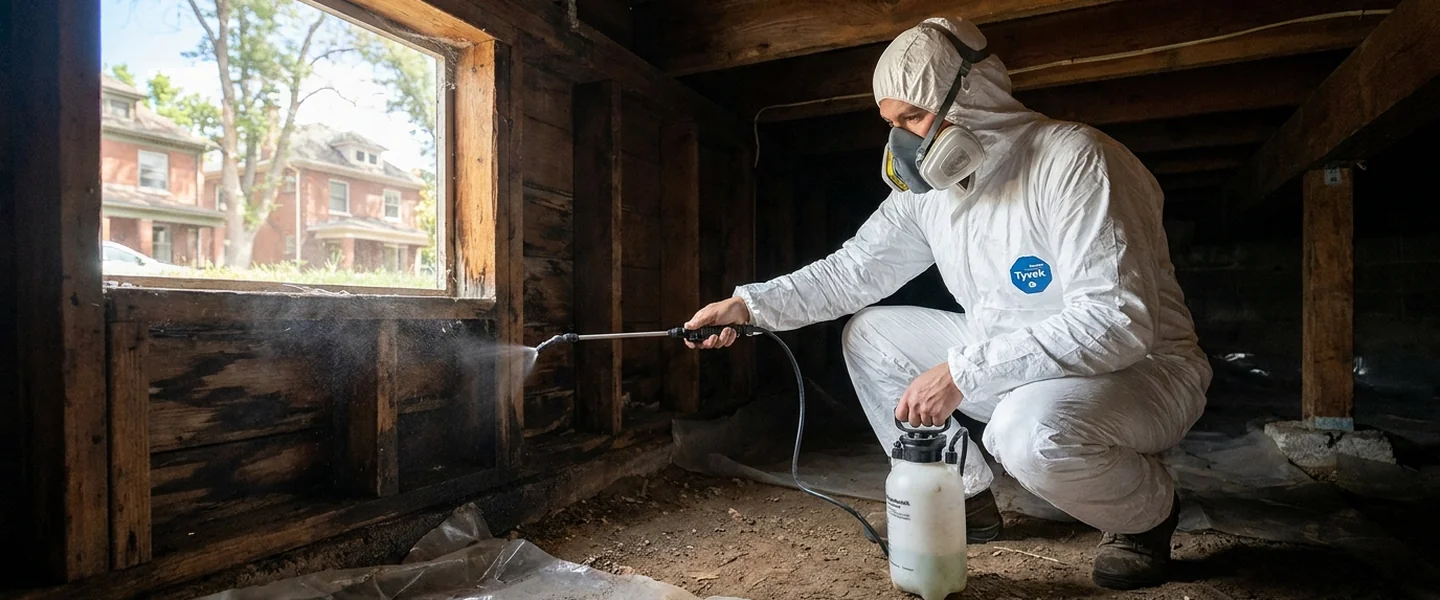
Before any physical remediation work begins, we establish HEPA-filtered containment at the crawlspace access point. Negative air pressure is maintained within the crawlspace relative to the living space, ensuring that disturbed mold spores are captured by the HEPA filtration unit rather than migrating into your home. Technicians wear full personal protective equipment including respirators rated for mold remediation.
Step 3: Affected Material Removal
Fiberglass batt insulation — the most common insulation type in Denver's older ranch homes — absorbs and retains moisture and cannot be cleaned once mold has colonized it. All affected insulation is bagged in sealed plastic and removed from the crawlspace for proper disposal. Severely affected wood framing members that cannot be cleaned to bare wood are assessed for replacement in coordination with structural considerations.
Step 4: Mechanical Abrasion (Wire Brush/Sanding)
Mold that has penetrated the surface fibers of wood framing requires mechanical abrasion to remove. We hand-sand or wire-brush all affected wood surfaces to remove mold growth down to the substrate. This step cannot be skipped — surface-applied antimicrobial treatments are not effective against subsurface mold growth in wood.
Step 5: EPA-Registered Antimicrobial Application
Following mechanical abrasion, all remediated surfaces are treated with an EPA-registered antimicrobial product. We use formulations specifically approved for structural wood remediation that encapsulate any residual mold material and inhibit regrowth. The antimicrobial is applied to all remediated surfaces, not just the visibly affected areas, to address any spore deposition in adjacent areas.
Step 6: Source Control — Encapsulation
Mold remediation without source control is a temporary fix. Once all visible mold has been removed and treated, we install a 20-mil reinforced vapor barrier encapsulation system to eliminate the moisture conditions that allowed mold to grow in the first place. This is the only approach that provides a long-term solution rather than repeated remediation cycles.
Denver-Area Homes Most at Risk
Based on our experience across the Denver metro area, the following housing types and neighborhoods present the highest crawlspace mold risk:
- Lakewood ranches (80226): Mid-century ranches along the Colfax Corridor and near Belmar with original single-thickness vapor barriers. Many have had the same plastic sheeting in place for 40 to 60 years.
- Arvada homes (80003): 1950s-1970s construction near Olde Town Arvada with failing fiberglass batt insulation. Original vapor barriers are often displaced or torn.
- Englewood post-war homes (80110): Post-WWII construction along Little Dry Creek with aging infrastructure and high soil moisture near the creek corridor.
- Aurora ranch neighborhoods (80012): 1970s-1990s homes near Buckingham Square with higher water table areas that drive elevated vapor pressure from below.
- Westminster homes near creek corridors (80031): Sandy-clay soil mix and proximity to creek corridors creates seasonal high-moisture conditions.
Health Risks of Crawlspace Mold
Mold growth in a crawlspace is not isolated from the living space above. Researchers have documented what is called the "stack effect" — warm air rises through a house and escapes through the upper levels, drawing replacement air in from below through the crawlspace and floor penetrations. This airflow carries mold spores, VOCs from mold metabolism, and elevated humidity directly into your living environment.
Common health symptoms associated with exposure to crawlspace mold include persistent respiratory irritation, worsening asthma symptoms, unexplained allergy-like symptoms indoors, musty odors in the home (particularly on first floors), and increased frequency of respiratory illness in household members. Children, the elderly, and those with compromised immune systems are most susceptible.
Frequently Asked Questions
Can mold really grow in a Denver crawlspace?
Yes, and it is more common than most Denver homeowners realize. Mold requires humidity above approximately 60 to 70 percent relative humidity, organic material (wood), and darkness. Denver crawlspaces — especially in older homes with failing vapor barriers — routinely exceed these humidity thresholds despite the dry outdoor climate. The crawlspace environment is insulated from outdoor air by the structure itself, allowing interior humidity to build regardless of outdoor conditions.
How do I know if my crawlspace has mold?
The most reliable way to confirm crawlspace mold is a professional inspection. Common indicators include: musty or earthy odors when entering the home or near floor vents; visible dark staining on floor joists or subfloor decking; high indoor humidity or condensation on windows; persistent respiratory symptoms in household members; and deteriorating or wet fiberglass insulation falling from the floor joists.
Can I treat crawlspace mold myself?
Small surface mold colonies on a very limited area may be addressable with consumer products, but this approach is not recommended for crawlspace mold for several reasons. Crawlspace conditions put untrained individuals at significant respiratory risk. Consumer antifungal products are often not EPA-registered for structural remediation and cannot address mold that has penetrated wood fibers. Most importantly, without HEPA containment, DIY mold disturbance can spread spores into the living space at concentrations far higher than the existing condition.
How long does crawlspace mold remediation take?
Most crawlspace mold remediation projects in the Denver area take one to two days for the remediation phase, plus one additional day for encapsulation installation. Severely affected spaces with extensive insulation removal and significant mold growth may require additional time. We provide a detailed timeline in your written estimate after the on-site inspection.
Will my homeowner's insurance cover crawlspace mold remediation?
Coverage depends on your specific policy and the cause of the mold. Mold resulting from a sudden, covered event (like a burst pipe) is more likely to be covered than mold resulting from long-term moisture accumulation from a failing vapor barrier. We can provide documentation of the mold extent and likely cause to support an insurance claim, but coverage determination is made by your insurer.
What antimicrobial products do you use?
We use EPA-registered antimicrobial products specifically approved for structural wood remediation. The specific products used depend on the mold species present and the surface type. All products we use carry EPA registration numbers and are applied according to label directions by trained technicians. We do not use bleach-based products on structural wood, as bleach is not effective against mold that has penetrated wood fibers.
How do I prevent crawlspace mold from coming back?
The only reliable way to prevent recurring crawlspace mold is to permanently correct the moisture conditions that allowed it to grow. This means installing a 20-mil vapor barrier encapsulation system, sealing foundation vents, insulating the foundation walls, and operating an altitude-rated dehumidifier to maintain below 50% relative humidity. Mold cannot grow below 60% relative humidity on dry structural wood.
Is a mold inspection the same as mold testing?
No. A visual inspection identifies visible mold growth and conditions conducive to mold. Mold testing — including air sampling and surface swab testing — identifies specific mold species and quantifies spore counts. Testing is useful for confirming that a remediation was successful or for identifying mold that is not yet visible. We can arrange for a third-party certified industrial hygienist to perform testing if needed.
Schedule a Free Crawlspace Mold Inspection in Denver
We serve Denver and surrounding suburbs including Aurora, Arvada, Lakewood, Centennial, Englewood, and Westminster.
Call (970) 557-2269 — Free Estimate