Denver Crawlspace Services
Crawlspace Dehumidifier Installation in Denver, CO
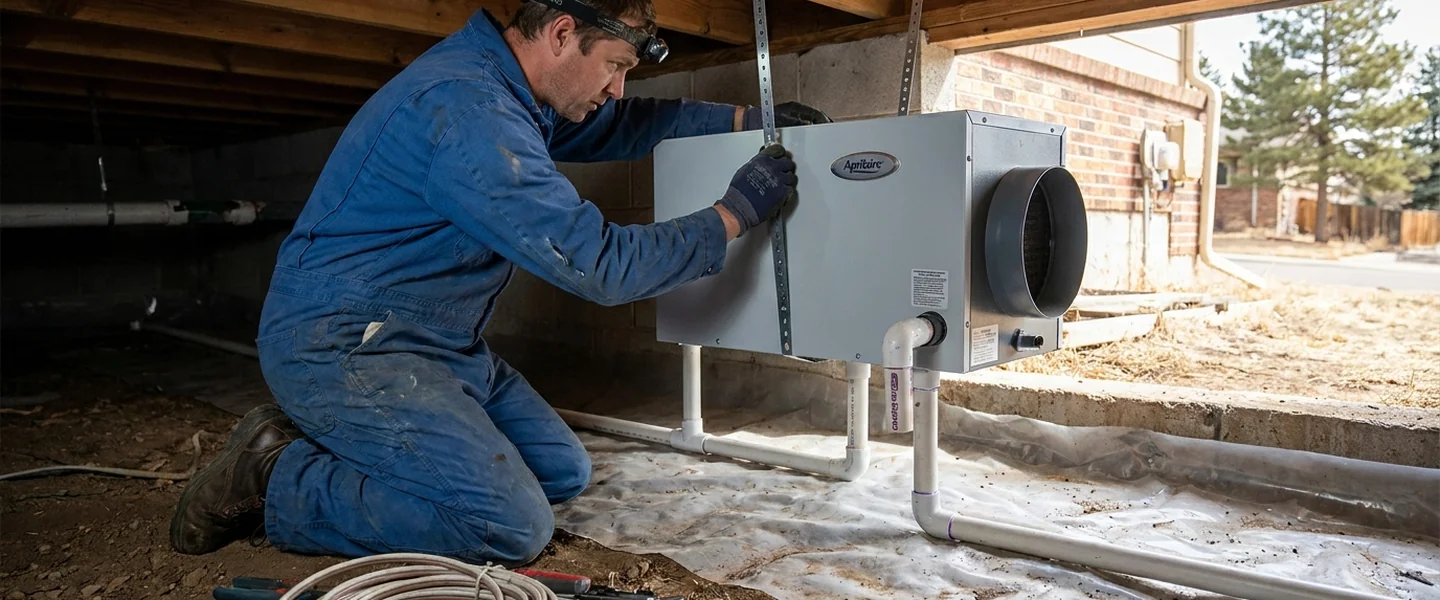
Altitude-rated Aprilaire and Santa Fe dehumidifiers properly sized for Denver's 5,280-foot elevation. Dedicated circuit, condensate plumbing, and automatic humidity control installed by certified technicians.
Call (970) 557-2269 — Free EstimateWhy Standard Dehumidifiers Fail in Denver's Crawlspaces
One of the most common mistakes Denver homeowners make when addressing crawlspace moisture is installing a standard residential dehumidifier — the type sold at big-box home improvement stores — and assuming the problem is solved. Within months, they find that humidity levels in the crawlspace remain elevated, musty odors persist, and the unit runs constantly without achieving the target humidity level. The cause is almost always the same: altitude.
All dehumidifier performance ratings — pints per day capacity, energy factor ratings, coverage area specifications — are measured at sea-level conditions: 65°F ambient temperature and 60% relative humidity. Denver sits at 5,280 feet above sea level, where atmospheric pressure is approximately 17 percent lower than at sea level. Dehumidifiers work by drawing warm, humid air over cold refrigerant coils, causing moisture to condense and drip into a collection bucket or drain. That condensation process depends directly on air pressure — lower pressure means lower air density, fewer water molecules per cubic foot of air, and reduced condensation efficiency on the coils.
The practical result: a standard 70-pint-per-day dehumidifier installed in a Denver crawlspace will typically remove only 50 to 55 pints per day under the same conditions it would hit 70 pints at sea level. That gap — 15 to 20 pints per day of unmanaged moisture — is often the difference between a controlled crawlspace and a mold-permissive environment. Denver Crawlspace Pros specifies only altitude-rated or commercial-grade units that have been independently tested and rated at elevations comparable to Denver.
Crawlspace Dehumidifier vs. Standard Dehumidifier
Beyond altitude, there are fundamental differences between standard portable dehumidifiers and the commercial-grade units we install in Denver crawlspaces:
Continuous Drainage
Standard dehumidifiers fill a reservoir bucket that must be manually emptied — sometimes daily during high-humidity periods. In a crawlspace, that is not a practical option. Commercial crawlspace dehumidifiers are designed exclusively for continuous drainage through a gravity drain line or a built-in condensate pump that automatically discharges to a floor drain, sump, or exterior point. Our installations include all necessary condensate plumbing as part of the project.
Sealed or Filtered Air Paths
Standard dehumidifiers pull in room air from all directions. Commercial crawlspace units are designed to draw air from a specific zone, filtrate it through a washable or replaceable filter, and return dehumidified air into the crawlspace. This creates a controlled airflow pattern that ensures all areas of the crawlspace benefit from dehumidification, not just the immediate vicinity of the unit.
Operating Temperature Range
Standard residential dehumidifiers typically stop operating — or ice up and shut down — below 60°F. Denver crawlspaces routinely drop below 60°F in fall, winter, and early spring. Commercial crawlspace dehumidifiers are designed to operate efficiently down to 40°F, covering the full range of temperatures a Denver crawlspace experiences throughout the year.
Duty Cycle and Longevity
A standard portable dehumidifier is designed for intermittent use in a living space. Commercial crawlspace dehumidifiers are engineered for continuous, year-round operation and typically carry 5-year manufacturer warranties compared to 1 to 2-year warranties on standard units. Over a 10-year period, one commercial unit almost always outlasts multiple replacement standard units — and performs better throughout.
Units We Install
Aprilaire 1820
The Aprilaire 1820 is a 130-pint-per-day (AHAM conditions) commercial crawlspace dehumidifier with an integrated fan for whole-crawlspace air circulation. It operates down to 40°F, includes a built-in humidistat with digital display, and filters through a washable 8-MERV filter. The 1820 is ENERGY STAR certified and draws 7.7 amps on a standard 120V circuit. For larger Denver crawlspaces over 1,500 square feet, the Aprilaire 1830 (185-pint capacity) may be specified.
Santa Fe Compact70
The Santa Fe Compact70 removes 70 pints per day (at AHAM conditions) and is specifically designed for crawlspace installation with a low-profile form factor that fits easily in confined spaces. It operates to 40°F, includes a built-in dehumidistat, and uses a 14-MERV filter for particulate removal. The Compact70 is ENERGY STAR rated and well-suited for Denver crawlspaces under 1,000 square feet. The Santa Fe Classic (120 pints) is specified for larger spaces.
Installation Process
Load Calculation
Before specifying a unit, we calculate the moisture load for your specific crawlspace based on square footage, ceiling height, soil type, encapsulation condition, and measured humidity levels. This calculation ensures we install sufficient capacity — not just the smallest unit that fits.
Dedicated Electrical Circuit
Commercial dehumidifiers require a dedicated 120V, 15-amp GFCI-protected circuit. We coordinate with a licensed electrician for circuit installation if one does not already exist. Operating a commercial dehumidifier on a shared circuit risks nuisance tripping and can cause the unit to operate below rated capacity if voltage drops under combined load.
Unit Placement and Elevation
The unit is mounted on a platform or placed on concrete blocks to elevate it above any potential water intrusion events and to improve air circulation beneath the unit. Placement is selected to maximize airflow coverage of the entire crawlspace footprint.
Condensate Plumbing
A continuous condensate drain line is run from the unit to the most practical exit point — either a sump pit, floor drain, or daylight exit through the foundation. We calculate the drainage slope and, if gravity drainage is not possible, install the unit's built-in condensate pump or specify an external pump station.
Humidistat Setting and Commissioning
After installation, the unit is set to maintain 50% relative humidity or lower. We commission the unit, verify that it reaches operating conditions, and confirm condensate drainage is functioning before leaving. We provide a written record of the installation including unit model, serial number, and humidistat setting.
Specifications
| Specification | Aprilaire 1820 | Santa Fe Compact70 |
|---|---|---|
| Rated Capacity (AHAM) | 130 pints/day | 70 pints/day |
| Min. Operating Temp | 40°F | 40°F |
| Amperage | 7.7A @ 120V | 5.5A @ 120V |
| Filter Type | MERV-8 washable | MERV-14 replaceable |
| ENERGY STAR | Yes | Yes |
| Built-in Pump | Optional | Yes |
| Crawlspace Coverage | Up to 2,200 sq ft | Up to 1,000 sq ft |
| Warranty | 5 years | 6 years |
Frequently Asked Questions
Does altitude really affect dehumidifier performance?
Yes, significantly. At Denver's 5,280-foot elevation, atmospheric pressure is approximately 17 percent lower than at sea level. Dehumidifiers rely on refrigerant condensation to remove moisture from air, and that process is pressure-dependent. A standard unit rated for 70 pints per day at sea level will typically remove only 50 to 55 pints per day at Denver's elevation — a 20 to 30 percent reduction in effectiveness.
Can I use a standard portable dehumidifier in my Denver crawlspace?
We strongly recommend against it for three reasons: altitude reduces their capacity significantly; they require manual bucket emptying which is not practical in a crawlspace; and most standard units are not designed to operate in the sub-60°F temperatures common in Denver crawlspaces during winter. Commercial crawlspace units address all three limitations.
Do I need a dehumidifier if my crawlspace is already encapsulated?
In most cases, yes. Even with a fully encapsulated crawlspace, moisture migrates upward from the soil through the vapor barrier (at a very low rate), and any concrete surfaces within the space off-gas moisture as they cure and through seasonal temperature cycling. A properly sized dehumidifier ensures that residual moisture does not accumulate to levels that could support mold growth on wood framing or cause structural issues.
What humidity level should I maintain in my Denver crawlspace?
The target is 50% relative humidity or lower. Mold cannot grow on wood surfaces when relative humidity is maintained below 60%, and structural wood remains dimensionally stable and does not experience significant degradation at or below 50%. In Denver's drier months (winter and fall), crawlspace humidity may drop below 40% naturally, which is not harmful but can cause wood to dry and contract slightly.
How much does it cost to run a crawlspace dehumidifier?
Operating costs vary by unit size, local electricity rate, and how much moisture the unit needs to manage. Both Aprilaire and Santa Fe units we install are ENERGY STAR certified, meaning they meet strict energy efficiency standards. As a general reference, an ENERGY STAR crawlspace dehumidifier running at moderate duty cycle (not continuous) typically uses 2 to 5 kWh per day — comparable to a refrigerator.
Does the dehumidifier need its own electrical circuit?
Yes. Commercial dehumidifiers should be on a dedicated 120V, 15-amp GFCI-protected circuit. Running a dehumidifier on a shared circuit can cause voltage drops under combined load, reducing the unit's efficiency and potentially causing nuisance breaker trips. A dedicated circuit also ensures the dehumidifier continues to run even if other devices on a shared circuit cause an interruption.
How often does a crawlspace dehumidifier need maintenance?
Commercial crawlspace dehumidifiers require minimal maintenance: filter cleaning or replacement every 6 to 12 months (depending on the unit and how dusty your crawlspace is), annual inspection of the condensate drain line to ensure it is clear, and a coil inspection every few years. Most units have indicator lights or app-based alerts for filter replacement. Annual professional inspection is recommended.
Can a dehumidifier replace a crawlspace encapsulation?
No. A dehumidifier manages humidity within the crawlspace air but does not address vapor migration from the soil, air infiltration through open vents, or thermal performance of the space. A dehumidifier is a component of a complete crawlspace system, not a substitute for encapsulation. Running a dehumidifier in an unencapsulated crawlspace is like trying to bail out a boat without plugging the leak — the unit will run constantly and still not maintain target humidity levels.
Get a Free Dehumidifier Installation Estimate in Denver
We size and install altitude-rated dehumidifiers for Denver-area crawlspaces. Same-week scheduling available.
Call (970) 557-2269 — Free Estimate