Denver Crawlspace Services
Crawlspace Insulation in Denver, CO
R-10 rigid foam on foundation walls, rim joist spray foam sealing, and complete replacement of failed fiberglass insulation. Colorado energy code compliant. Keeps Denver pipes from freezing.
Call (970) 557-2269 — Free EstimateThe Problem With Fiberglass Insulation in Denver Crawlspaces
Walk into almost any pre-1980s Denver ranch home crawlspace and you will find the same thing: pink or yellow fiberglass batt insulation stapled between the floor joists, hanging down like disheveled curtains, half of it fallen to the ground and the other half sagging under years of moisture absorption. This is the legacy of a crawlspace insulation strategy that was standard practice for decades but has since been understood to fail in Denver's climate.
Fiberglass insulation has two fundamental problems in Denver crawlspace applications. First, it is hygroscopic — it absorbs and holds moisture. When crawlspace humidity rises above 60 percent (common in unencapsulated Denver crawlspaces), fiberglass insulation absorbs that moisture and can hold it for weeks or months. Wet fiberglass loses 30 to 50 percent of its rated R-value, meaning R-19 batts may perform at R-10 or less when moisture-saturated. Second, the moisture-laden fiberglass creates an ideal substrate for mold growth on the facing material and on the adjacent wood framing it contacts.
The alternative approach that building science has validated — and that Colorado's energy code increasingly requires — is to insulate the foundation walls and rim joist rather than the floor system above. This approach brings the crawlspace into the thermal envelope of the house, keeping the crawlspace conditioned and protecting any mechanical systems (HVAC ducts, plumbing pipes) within it from Denver's cold winters.
Denver's Crawlspace Insulation Code Requirements
Colorado follows the International Energy Conservation Code (IECC), with modifications adopted by the Colorado Division of Housing. Denver and the Denver metro area fall within IECC Climate Zones 5 and 6, which have the following minimum crawlspace insulation requirements:
For unvented (encapsulated) crawlspaces, the IECC 2021 and Colorado's adopted amendments require:
- Foundation wall insulation: R-10 continuous rigid insulation on the interior of the foundation wall, or R-13 + R-5 continuous insulation on exterior
- Rim joist insulation: fully sealed with spray foam or a combination of rigid foam and spray foam perimeter seal
- Floor insulation above the crawlspace is not required when foundation walls are insulated to code
Our standard installation meets or exceeds these requirements and provides documentation for permit compliance when required by the local jurisdiction.
Rim Joist Insulation: The Highest-Impact Location
The rim joist — the band of framing lumber running along the top of the foundation wall where the floor joists connect — is one of the most significant sources of air infiltration and heat loss in Denver homes. In older construction, the rim joist area is typically uninsulated or partially insulated with fiberglass that has compressed and air-leaked over the decades.
Research from the Department of Energy has found that properly sealing and insulating the rim joist can reduce crawlspace air infiltration by 30 to 50 percent. Because the rim joist runs the entire perimeter of the home, even small gaps between the framing, sill plate, and foundation wall create significant cumulative air leakage.
We insulate and air-seal rim joists with two-component closed-cell spray polyurethane foam applied to a minimum 2-inch thickness (R-12). The spray foam expands to fill every gap and void in the rim joist area, providing simultaneous insulation and air sealing in a single material. Closed-cell foam is also a Class II vapor retarder, providing an additional layer of moisture protection at this critical location.
Foundation Wall Insulation
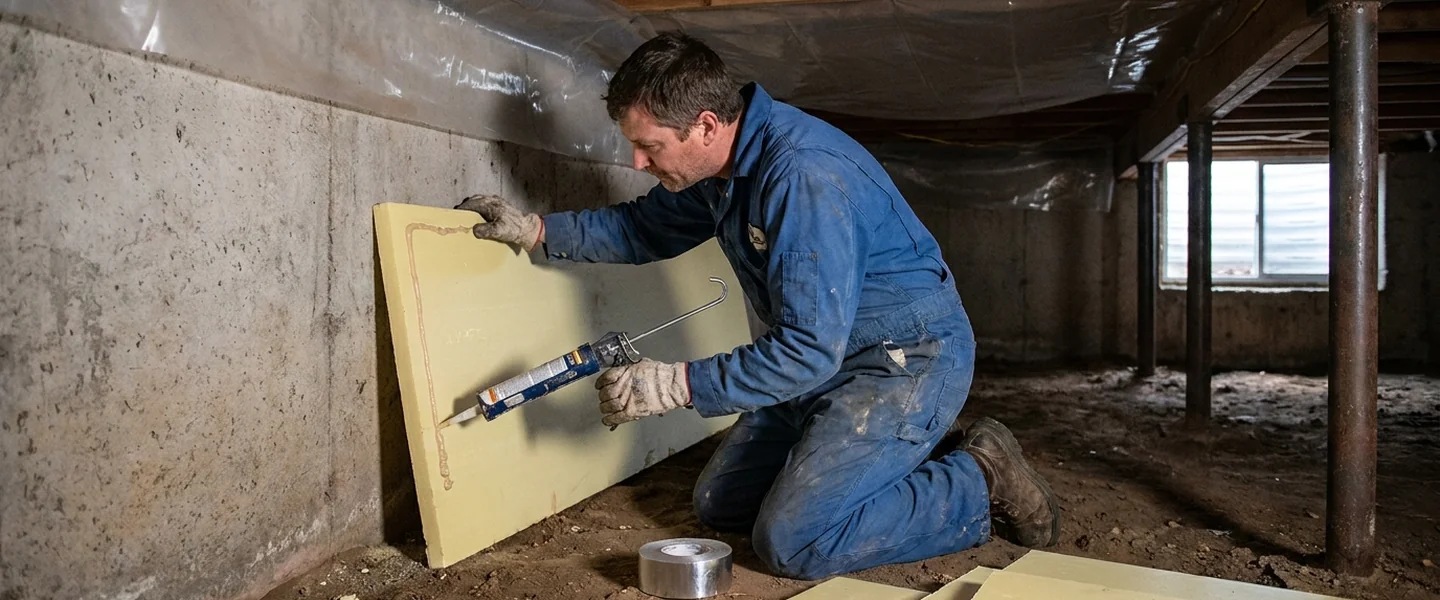
R-10 continuous rigid foam insulation is installed on the interior face of the foundation wall, running from the sill plate down to the vapor barrier on the crawlspace floor. We use rigid extruded polystyrene (XPS) or polyisocyanurate panels, both of which are dimensionally stable, moisture-resistant, and maintain their rated R-value in the damp crawlspace environment unlike fiberglass.
The panels are mechanically fastened to the foundation wall and the perimeter seams are sealed with foam or caulk to eliminate air infiltration pathways. In homes with block foundation walls — common in Aurora and other older Denver suburbs — we take additional care to seal the cores of the block, which can be significant air infiltration channels.
Protecting Denver Pipes From Freezing
Denver's winters are cold enough to freeze water pipes in exposed or inadequately insulated crawlspaces. Colorado sees sub-zero temperatures multiple times per winter in most years, and the combination of cold outdoor air and wind infiltration through open foundation vents can drive crawlspace temperatures below freezing. Plumbing supply lines in crawlspaces are among the most common sources of freeze damage in Denver homes.
When the crawlspace is properly insulated — foundation walls to R-10, rim joist sealed and insulated, vents closed — the crawlspace temperature is buffered by the thermal mass of the soil and the heat loss from the conditioned living space above. In most Denver homes, a properly encapsulated and insulated crawlspace maintains temperatures above freezing throughout the winter without any supplemental heating, providing reliable freeze protection for supply lines and drain pipes within the space.
Vapor-Permeable vs. Vapor-Impermeable Insulation
Not all rigid foam insulation has the same vapor permeance, and the difference matters in a Denver crawlspace application.
Extruded Polystyrene (XPS): Rated at 0.6 to 1.2 perms at 1-inch thickness — a Class II vapor retarder. Excellent for foundation wall applications where some vapor diffusion management is needed. Blue or pink board. R-5 per inch.
Polyisocyanurate (Polyiso): Rated at approximately 2 to 3 perms — vapor permeable. Lower moisture resistance than XPS but higher R-value per inch (R-6.5 to R-7 per inch). Better suited for applications where vapor management is handled by the vapor barrier below.
Closed-Cell Spray Foam: Rated at 0.8 to 1.2 perms at 2-inch thickness — a Class II vapor retarder. The most effective air-sealing insulation available. We use this exclusively at rim joists where air sealing is the primary objective.
Our standard specification uses XPS rigid foam on foundation walls for its balance of R-value, moisture resistance, and vapor management, combined with closed-cell spray foam at the rim joist for superior air sealing.
Old Fiberglass Removal
Before installing any new insulation, we remove all existing fiberglass batt insulation from the floor joists and dispose of it properly. Fiberglass that has been in a Denver crawlspace for more than 15 to 20 years is typically moisture-damaged, often host to insect or rodent nesting activity, and in some cases harboring mold growth on the kraft paper facing. Retaining old fiberglass in a newly encapsulated crawlspace undermines the entire system — contaminated insulation continues to off-gas moisture and can harbor active mold that the encapsulation will not remediate.
Frequently Asked Questions
Should I insulate the crawlspace floor or the walls?
In Denver's climate, insulating the foundation walls (rather than the floor above) is the recommended approach when the crawlspace is being encapsulated. Wall insulation brings the crawlspace into the thermal envelope of the house, protects pipes and HVAC equipment from freezing, and eliminates the thermal bridging that occurs when floor joist bays are insulated. Floor insulation above the crawlspace is appropriate only in vented crawlspace designs, which we do not recommend in Colorado's climate.
Why do I need R-10 if my existing fiberglass is R-19?
The R-value of fiberglass insulation in a Denver crawlspace is almost certainly not R-19. Fiberglass loses 30 to 50 percent of its rated R-value when wet or compressed. After 10 to 20 years in a damp crawlspace environment, R-19 fiberglass often performs at R-10 or less. Additionally, fiberglass installed between floor joists provides no air sealing — conditioned air from the living space flows freely through the joist bays and into the crawlspace. R-10 continuous rigid foam on foundation walls provides true air sealing and consistent thermal performance that fiberglass between floor joists cannot match.
Will insulating my crawlspace walls help with frozen pipes?
Yes, significantly. When foundation walls are insulated and foundation vents are sealed, the crawlspace is buffered from outdoor temperatures by the soil's thermal mass and the heat loss from the living space above. In most Denver homes, a properly insulated and encapsulated crawlspace maintains temperatures above freezing throughout the winter, protecting supply lines and drain pipes from freeze damage without supplemental heat.
Do I need a vapor barrier if I'm insulating the foundation walls?
Yes. Foundation wall insulation and a floor vapor barrier serve different functions. The wall insulation manages thermal performance and reduces air infiltration. The floor vapor barrier controls moisture vapor migration from the soil into the crawlspace air. Both are needed for a complete, properly functioning encapsulated crawlspace system. Installing one without the other leaves the system incomplete and less effective.
Is spray foam better than rigid foam for crawlspace walls?
Spray foam provides superior air sealing and is our preferred material for rim joist applications. For foundation walls, rigid foam is typically more cost-effective for equivalent R-value while still providing excellent air sealing when properly installed with sealed seams and perimeter edges. We use closed-cell spray foam at the rim joist — the most critical air-sealing location — and rigid foam on the foundation walls for the best performance across the entire crawlspace envelope.
How long does crawlspace insulation installation take?
Insulation installation as part of a full encapsulation typically adds two to four hours to the overall project timeline. When performed as a standalone service (for example, adding wall insulation to a previously encapsulated crawlspace), it typically takes four to six hours for an average Denver ranch home crawlspace, depending on perimeter length and crawlspace height.
Will crawlspace insulation affect my energy bills?
Yes, typically by 10 to 25 percent in heating costs, depending on the existing condition of the crawlspace. Sealing the rim joist eliminates one of the largest air infiltration pathways in most older Denver homes. Insulating the foundation walls reduces heat loss to the soil. Combined with encapsulation, these improvements allow your HVAC system to maintain set temperatures with less energy consumption during Denver's cold winters.
Does crawlspace insulation require a permit in Denver?
Crawlspace insulation that is part of a full encapsulation project — including vent sealing and vapor barrier installation — may require a building permit in Denver and surrounding municipalities. Permit requirements vary by jurisdiction. Denver Crawlspace Pros can advise on permit requirements for your specific location and provide all documentation needed for permit applications and inspections.
Get a Free Crawlspace Insulation Estimate in Denver
We replace failed fiberglass with code-compliant rigid foam and spray foam insulation systems built for Colorado's climate.
Call (970) 557-2269 — Free Estimate