Denver Crawlspace Services
Crawlspace Encapsulation in Denver, CO
20-mil reinforced vapor barrier systems designed for Denver's altitude, freeze-thaw cycles, and clay-heavy soils. IRC R408.3 compliant. 25-year Stego material warranty. Same-week scheduling.
Call (970) 557-2269 — Free EstimateWhy Denver Homes Need Full Crawlspace Encapsulation
Denver's reputation as a dry, sunny city leads many homeowners to overlook their crawlspace until significant damage has already occurred. The truth is that Denver's climate creates a combination of stressors on crawlspace environments that few other regions can match. The Front Range's dramatic temperature swings, freeze-thaw cycles, clay-heavy soil profiles, and high-altitude humidity dynamics all work against thin, partial vapor barriers and open-vent crawlspace designs.
A crawlspace encapsulation system seals the entire crawlspace environment — floors, walls, and piers — with a continuous, reinforced vapor barrier, eliminates conditioned outside air infiltration by sealing foundation vents, and manages residual humidity with a properly sized, altitude-rated dehumidifier. The result is a controlled, dry enclosure that protects your framing, insulation, mechanicals, and floor system for decades.
Denver Crawlspace Pros installs fully encapsulated systems using 20-mil reinforced polyethylene — the same barrier thickness used in commercial and new-construction applications. This is four times thicker than the 5-mil or 6-mil plastic commonly found in Denver homes built before 1990. Thicker barriers resist puncture from foot traffic, pest activity, and the minor ground movement that occurs with Colorado's seasonal freeze-thaw cycles. Our installations meet and exceed the IRC R408.3 requirements for crawlspace encapsulation in conditioned and semi-conditioned spaces.
Denver-Specific Crawlspace Challenges We Address
Altitude and Dehumidifier Performance
Standard residential dehumidifiers are rated at sea-level conditions — 65°F, 60% relative humidity. At Denver's 5,280-foot elevation, atmospheric pressure is roughly 17 percent lower than sea level. Dehumidifiers move water vapor by condensing it on cold coils, and that process depends on air pressure. At elevation, a unit rated for 70 pints per day may only remove 50 to 55 pints — leaving significant moisture unmanaged. Denver Crawlspace Pros specifies and installs units rated for high-altitude performance, and we right-size each system based on your crawlspace square footage and measured humidity levels.
Freeze-Thaw Cycle Vapor Barrier Degradation
Colorado's freeze-thaw cycles are relentless from October through April. Each freeze cycle causes minor heaving in the soil beneath and around your foundation. Over years and decades, that movement shifts, wrinkles, and abrades thin vapor barriers until they fail. We've removed original 6-mil barriers from 1960s-era Denver ranch homes that had degraded into fragments scattered across the crawlspace floor. A 20-mil reinforced barrier — properly lapped, seamed with moisture-cure tape, and fastened at the perimeter — has the structural integrity to survive decades of Colorado ground movement.
Clay Soil Moisture Retention
Many Denver-area neighborhoods — Aurora, Englewood, Westminster, and parts of Lakewood — sit on clay-heavy soil profiles. Clay retains water and releases it slowly, creating sustained upward vapor pressure against any vapor barrier from below. Clay soil near a foundation can maintain near-saturation conditions for weeks after a snowmelt or rain event. This is why vapor pressure rating matters as much as thickness: a 20-mil barrier rated to 0.02 perms provides 20 times the vapor resistance of a 6-mil barrier rated at 0.4 perms.
Older Ranch Home Construction
Denver's suburban housing stock is dominated by ranch homes built from the 1950s through the 1970s. These homes were designed with vented crawlspaces — a standard that has been reconsidered in modern building science. Open foundation vents allow humid outdoor air into the crawlspace in summer, where it meets the cooler crawlspace floor and condenses. Fiberglass batt insulation draped between floor joists absorbs that moisture, loses thermal performance, and eventually becomes a biological substrate. Our encapsulation systems seal all foundation vents and replace failed fiberglass insulation with closed-cell solutions on the foundation walls.
Our 6-Step Encapsulation Process
Free On-Site Assessment
We crawl the entire space, measure humidity, inspect framing and insulation, photograph all areas of concern, and provide a written scope of work with no obligation.
Debris Removal and Site Preparation
We remove all failed insulation, degraded vapor barrier material, and debris from the crawlspace floor and walls before any new material is installed.
Foundation Vent Sealing
All existing foundation vents are sealed with rigid foam insulation panels and spray foam perimeter sealing, eliminating the primary source of humidity infiltration.
20-mil Vapor Barrier Installation
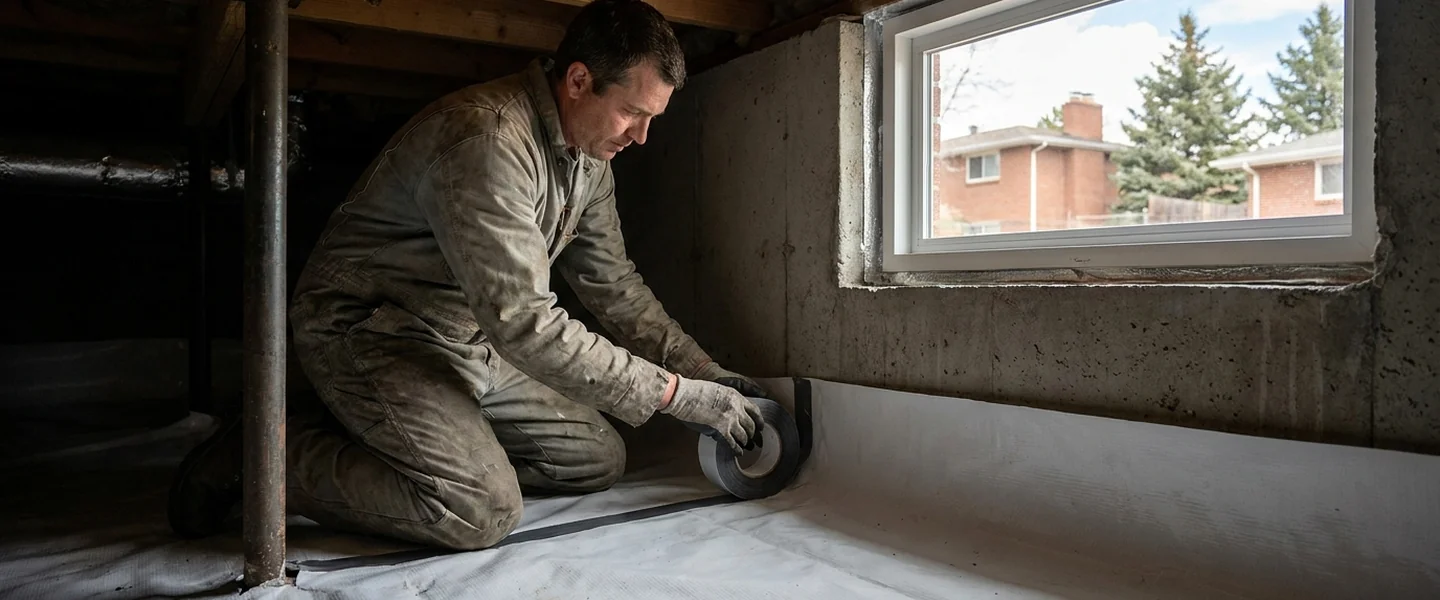
The 20-mil reinforced polyethylene liner is installed across the crawlspace floor and lapped up all foundation walls and piers. Seams are overlapped a minimum of 12 inches and sealed with moisture-cure tape. The perimeter is fastened to the foundation wall above the sill plate.
Wall Insulation and Rim Joist Sealing
R-10 rigid foam insulation is installed on the interior of the foundation walls. The rim joist — the wood framing at the top of the foundation wall — is sealed with two-component spray foam to eliminate the highest-volume air infiltration point in most crawlspaces.
Altitude-Rated Dehumidifier Installation
A commercial-grade, altitude-rated dehumidifier is installed on a platform within the encapsulated space, connected to a dedicated electrical circuit and plumbed to a gravity or pumped condensate drain. The unit is set to maintain 50% relative humidity or lower year-round.
Specifications and Materials
| Component | Specification | Standard |
|---|---|---|
| Vapor Barrier | 20-mil reinforced polyethylene (Stego Wrap 20-mil or equivalent) | ASTM E1745 Class A |
| Vapor Permeance | 0.02 perms (Class II vapor retarder) | IRC Section R702.7 |
| Seam Tape | Moisture-cure seam tape, minimum 4-inch wide | Manufacturer specified |
| Foundation Wall Insulation | R-10 minimum rigid foam, continuous | IECC 2021 Table R402.1.3 |
| Rim Joist | Two-component closed-cell spray foam, minimum 2-inch thickness | IRC R806.5 |
| Vent Sealing | Rigid foam insert + spray foam perimeter seal | IRC R408.3 |
| Dehumidifier | Aprilaire 1820 or Santa Fe Compact70 (altitude-rated) | ENERGY STAR certified |
| Electrical | Dedicated 120V, 15A circuit with GFCI protection | NEC 210.8(A) |
Warranty
Every crawlspace encapsulation we install is backed by two warranties:
- 25-Year Material Warranty: Stego Industries provides a 25-year limited warranty against material defects on their 20-mil reinforced vapor barriers. This is among the strongest material warranties in the industry.
- 10-Year Workmanship Warranty: Denver Crawlspace Pros guarantees all labor, seaming, wall attachment, and vent sealing for 10 years from the installation date. If any portion of our installation fails due to workmanship, we return and correct it at no charge.
Frequently Asked Questions
What is crawlspace encapsulation?
Crawlspace encapsulation is the process of sealing your crawlspace from moisture infiltration by installing a continuous vapor barrier across the floor and walls, sealing all foundation vents, insulating the foundation walls, and installing a dehumidifier to manage residual humidity. The result is a controlled, dry environment that protects your home's structure, insulation, and mechanicals.
Is crawlspace encapsulation worth it in Denver's dry climate?
Yes — and this is one of the most common misconceptions Denver homeowners have. Denver's surface climate is dry, but crawlspace environments accumulate moisture from soil vapor, temperature cycling, and snowmelt infiltration. The freeze-thaw cycles, dramatic daily temperature swings, and clay soil profiles in many Denver neighborhoods make crawlspace moisture management essential, not optional.
What thickness vapor barrier do I need in Denver?
We install 20-mil reinforced polyethylene in all Denver-area crawlspaces. The minimum IRC requirement is 6-mil, but 6-mil barriers are not durable enough for Colorado's freeze-thaw cycles, ground movement, and high-traffic maintenance access. A 20-mil barrier has four times the puncture resistance and 20 times the vapor resistance of a standard 6-mil barrier.
How long does crawlspace encapsulation take?
Most residential crawlspace encapsulation projects in Denver take one to two days for the crew. Smaller crawlspaces under 800 square feet are typically completed in a single day. Larger spaces with significant debris removal, mold remediation needs, or structural repairs may require two to three days. We provide a specific timeline in your written estimate.
Do I need to seal my crawlspace vents?
Yes. In Denver's climate, open foundation vents are a net negative — they bring in more moisture during spring, summer, and fall than they remove. Modern building science and the IRC both recognize that encapsulated, sealed crawlspaces perform better than vented crawlspaces in most climate zones, including Colorado's climate zones 5 and 6. We seal all vents as part of every encapsulation.
Will I need a dehumidifier after encapsulation?
In most Denver-area crawlspaces, yes. Even after encapsulation, residual moisture from the soil and any concrete surfaces within the space will continue to migrate into the crawlspace air. A properly sized dehumidifier manages this residual humidity and maintains conditions below 50% relative humidity — the threshold below which mold cannot grow and structural wood remains stable.
Does crawlspace encapsulation improve energy efficiency?
Yes, typically by 10 to 25 percent in heating and cooling costs, depending on the existing condition of your crawlspace. Sealing the rim joist and foundation walls eliminates significant air infiltration, and maintaining a controlled humidity environment allows your floor system insulation to perform closer to its rated R-value. Wet insulation can lose 30 to 50 percent of its thermal performance.
What is IRC R408.3 and does my encapsulation need to meet it?
IRC R408.3 is the International Residential Code section governing unvented crawlspace enclosures. It requires a continuous Class II vapor retarder (0.1 perms or less), vent sealing, and mechanical ventilation or dehumidification to control humidity. Our standard encapsulation systems exceed all R408.3 requirements. We provide documentation of compliance for permit purposes when required.
Get a Free Crawlspace Encapsulation Estimate in Denver
We serve Denver, Aurora, Arvada, Lakewood, Centennial, Englewood, and Westminster. Same-week scheduling available.
Call (970) 557-2269 — Free Estimate